<!-- Google tag (gtag.js) --> <script async src="https://www.googletagmanager.com/gtag/js?id=G-FNVKYB7G4T"></script> <script> window.dataLayer = window.dataLayer || []; function gtag(){dataLayer.push(arguments);} gtag('js', new Date()); gtag('config', 'G-FNVKYB7G4T'); </script>



Saving money is one of the most practical ways to build financial security and prepare for future expenses. However, choosing the right savings account can make a difference in how much your money earns over time. The best savings account interest rates can help you earn interest on your deposits while keeping your funds accessible for emergencies and planned expenses. Whether you are saving for a home, education, travel, or long-term financial stability, understanding interest rates and account conditions is essential. By comparing available options, reviewing fees, and understanding your financial goals, you can make more informed decisions and develop better savings habits.
Table of Contents
What Are the Best Savings Account Interest Rates?
Savings account interest rates represent the percentage a bank pays you for keeping money in an eligible savings account. The interest you earn depends on the rate, your balance, the duration of your deposit, and the bank’s interest calculation method.
The best savings account interest rates are not necessarily the highest advertised rates. A suitable account should also offer transparent conditions, reasonable fees, convenient access to your money, and eligibility requirements that match your circumstances.
For example, if you deposit AED 20,000 into an account paying 3% annual interest, you could earn approximately AED 600 over one year, assuming the rate remains unchanged and interest is calculated on the original deposit without additional charges.
This example demonstrates why comparing rates is worthwhile. Even a small difference in interest can affect your total earnings over time.
Why Are Savings Account Interest Rates Important?
Interest rates influence how much your savings can earn without requiring you to invest in market-linked products. Although savings account returns may be modest compared with some investments, these accounts can provide convenient access to money needed for short-term goals.
Understanding the best savings account interest rates can help you:
- Earn interest: Receive returns on eligible deposits according to the account terms.
- Build an emergency fund: Keep money available for unexpected expenses.
- Manage your finances: Separate savings from everyday spending.
- Plan future expenses: Save towards education, travel, home purchases, or other goals.
- Compare banking options: Identify accounts that balance interest, fees, and accessibility.
A suitable savings account can support your financial plan without requiring you to expose money needed immediately to unnecessary investment risk.
7 Ways to Find the Best Savings Account Interest Rates
1. Compare Offers from Different Banks
Start by reviewing savings accounts offered by several banks. Compare their standard rates, promotional offers, minimum deposit requirements, and eligibility conditions.
The best savings account interest rates may vary depending on the account type, deposit amount, and customer category. Some banks offer higher rates to customers who maintain a qualifying balance or meet specific requirements.
Check whether the advertised rate applies to your entire balance or only to a particular portion. Always confirm the latest terms directly with the bank before making a decision.
2. Check Minimum Balance Requirements
Some savings accounts require customers to maintain a minimum balance to earn the advertised rate or avoid monthly maintenance charges.
For example, an account might offer attractive interest but require you to keep a substantial amount deposited. If your balance frequently falls below that threshold, the account may not provide the expected benefit.
Choose an account that fits your financial situation. Avoid tying up money you may need for essential expenses simply to qualify for a higher rate.
3. Understand How Interest Is Calculated
Banks may calculate interest daily or according to another specified method, while crediting it monthly, quarterly, or at different intervals.
Compounding occurs when previously credited interest remains in the account and begins earning interest itself. Over time, compounding can increase your total savings, depending on the rate and account terms.
When comparing the best savings account interest rates, check the interest calculation method, payment frequency, and whether the rate is fixed or variable.
4. Review Fees and Withdrawal Rules
An attractive interest rate may not provide good value if account fees reduce your earnings.
Before opening an account, review:
- Monthly maintenance charges.
- Minimum balance penalties.
- Withdrawal and transfer restrictions.
- Fees for specific transactions.
- Conditions attached to promotional interest rates.
If you need frequent access to your money, prioritise an account that combines competitive interest with convenient withdrawals.
5. Choose an Account That Matches Your Goals
Your savings account should support the reason you are saving.
For example, an emergency fund requires convenient access to money, while savings for a planned purchase several months away may allow you to consider different account conditions.
Before selecting an account, decide whether your priority is emergency savings, a future expense, or building a general financial reserve. The best savings account interest rates are most useful when the account also meets your practical needs.
6. Read Promotional Offers Carefully
Some banks offer introductory rates for new customers or qualifying deposits. These offers may be available only for a limited period or under specific conditions.
Check when the promotional rate expires, what rate applies afterward, and whether additional deposits qualify.
Do not assume that an advertised offer will continue indefinitely. Compare the potential earnings over the period you expect to keep the account rather than focusing only on the initial rate.
7. Review Your Savings Account Regularly
Interest rates, banking products, and your financial circumstances can change. Reviewing your account periodically helps you determine whether it continues to meet your needs.
Compare the current rate with other suitable options and consider any fees or restrictions associated with switching.
You do not need to change accounts every time a bank advertises a slightly higher rate. Focus on the overall benefit, convenience, and suitability of the account.
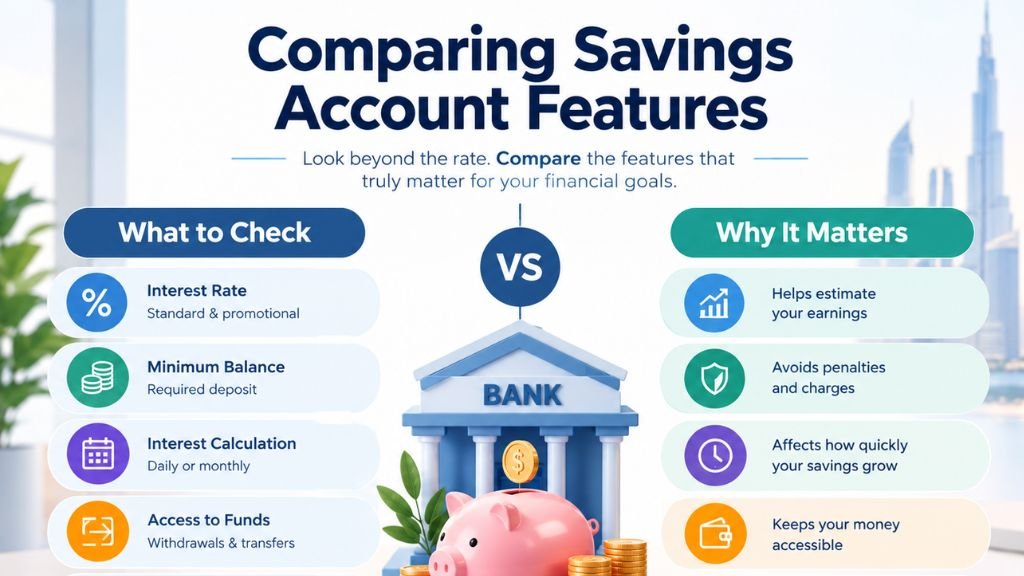
Comparing Savings Account Features
When evaluating the best savings account interest rates, consider more than the advertised percentage.
| Account Feature | What to Check | Why It Matters |
|---|---|---|
| Interest rate | Standard and promotional rates | Helps estimate potential earnings |
| Minimum balance | Required deposit amount | Helps avoid penalties |
| Interest calculation | Calculation and payment frequency | Affects how earnings accumulate |
| Accessibility | Withdrawal and transfer conditions | Determines access to funds |
| Account fees | Maintenance and transaction charges | Can reduce your returns |
| Eligibility | Residency and documentation | Confirms whether you qualify |
This comparison framework can help you evaluate savings accounts in the UAE and other markets. Actual interest rates and banking conditions vary by provider and account.
How Much Can You Earn from a Savings Account?
Your potential earnings depend on your starting balance, applicable interest rate, and the period your money remains deposited.
Consider an initial deposit of AED 20,000 held for one year.
| Annual Interest Rate | Approximate Interest Earned |
|---|---|
| 1% | AED 200 |
| 2% | AED 400 |
| 3% | AED 600 |
| 4% | AED 800 |
These figures are illustrative estimates based on a constant annual rate applied to the original balance. They exclude fees and additional deposits or withdrawals and do not represent current bank offers.
Comparing the best savings account interest rates can help you understand the potential difference between account options. However, variable rates can change, so use the bank’s current terms when estimating your actual earnings.
Finding Suitable Savings Options in the UAE
Residents and expatriates in the UAE can explore savings accounts offered by banks operating in the country. Account eligibility and benefits may vary according to residency status, minimum deposits, salary requirements, and other conditions.
When comparing the best savings account interest rates, check the currency, withdrawal rules, account fees, and any applicable deposit protection arrangements.
You may also seek professional guidance to understand how savings fit into your wider financial plan. Finance Companies in Dubai may provide financial planning or advisory services, but these services are different from bank deposit accounts. Check that any provider is appropriately authorised for the service it offers.
Before opening an account, confirm:
- The latest published interest rate.
- Whether the rate is fixed, variable, or promotional.
- Minimum balance and fee requirements.
- Access to your money when needed.
- Documentation and eligibility conditions.
- The relevant deposit protection arrangements.
A well-chosen savings account can help you maintain liquidity while working towards your financial goals.
Common Mistakes to Avoid
Choosing a savings account based only on its interest rate can lead to disappointing results. Consider these common mistakes before making a decision:
- Ignoring fees: Charges can reduce the interest you earn.
- Overlooking minimum balances: Falling below the required amount may affect returns or trigger penalties.
- Assuming rates never change: Variable interest rates can increase or decrease.
- Missing promotional conditions: Introductory rates may expire after a specified period.
- Confusing savings with investments: Investment products carry different risks and may expose your capital to losses.
- Ignoring accessibility: A restrictive account may not suit emergency savings.
The best savings account interest rates should be evaluated alongside account conditions, convenience, and your financial priorities.
How to Choose the Best Savings Account Interest Rates for Better Returns
Choosing the best savings account interest rates can help you make better use of your money while maintaining access to your savings. Before opening an account, compare interest rates from different banks, review minimum balance requirements, and check whether the advertised rate is fixed or variable. The best savings account interest rates should offer a suitable balance between competitive earnings, low fees, and convenient withdrawals. Whether you are building an emergency fund or saving for future expenses, understanding these features can help you select an account that supports your financial goals. Reviewing the latest banking offers regularly can also help you identify suitable savings opportunities.
Best Savings Account Interest Rates and Financial Planning in Dubai
Finding the best savings account interest rates is an important step towards effective financial planning in Dubai and across the UAE. A suitable savings account can help you manage short-term financial needs, prepare for unexpected expenses, and develop a consistent saving habit. When comparing the best savings account interest rates, consider account charges, interest calculation methods, eligibility requirements, and access to your money rather than focusing only on the advertised percentage. Finance Companies in Dubai that provide authorised financial advisory services may also help you understand how savings fit into your overall financial plan. At Bricks Consultancy, you can explore financial planning guidance to help organise your financial priorities and work towards your future goals.
Frequently Asked Questions
1. How do I find the best savings account interest rates?
Compare offers from multiple banks, including standard interest rates, fees, minimum balances, withdrawal rules, and eligibility requirements. Confirm the current terms directly with each bank.
2. Are savings account interest rates fixed?
Not always. Some accounts offer fixed rates for a specified period, while others have variable rates that may change. Review the account agreement before depositing your money.
3. How often is savings account interest paid?
The payment frequency depends on the bank and account. Interest may be credited monthly, quarterly, or at another specified interval. Check the account terms for details.
4. Can expatriates open savings accounts in the UAE?
Eligibility depends on the bank’s requirements, residency status, identification documents, and account type. Contact the bank to confirm the latest requirements.
5. Are savings accounts better than investments?
They serve different purposes. Savings accounts generally offer convenient access to deposits, subject to account terms, while investments may provide higher potential returns with a risk of losses. Your choice should depend on your goals, timeframe, and risk tolerance.
Related Financial Topics to Explore
Readers researching savings accounts may also benefit from learning about:
- High-interest savings accounts.
- Savings accounts in the UAE.
- Monthly savings plans in Dubai.
- Emergency fund planning.
- Compound interest and savings growth.
- Financial planning for expatriates.
Understanding these topics can help you make informed decisions about saving, managing cash, and preparing for future expenses.
Conclusion
Choosing the best savings account interest rates requires more than selecting the highest advertised percentage. You should compare interest calculations, fees, minimum balance requirements, withdrawal conditions, promotional offers, and eligibility before opening an account.
Start by identifying your financial goals, comparing suitable banking options, and checking the latest terms directly with each provider. Maintain a realistic savings target and review your account periodically to ensure it continues to meet your needs.
For additional guidance on organising your finances, consider speaking with a qualified financial adviser. Bricks Consultancy can help you explore financial planning and related advisory services in the UAE.
Take action today: Review your savings goals, compare available accounts, and choose a suitable option to help you build a stronger financial future.