<!-- Google tag (gtag.js) --> <script async src="https://www.googletagmanager.com/gtag/js?id=G-FNVKYB7G4T"></script> <script> window.dataLayer = window.dataLayer || []; function gtag(){dataLayer.push(arguments);} gtag('js', new Date()); gtag('config', 'G-FNVKYB7G4T'); </script>


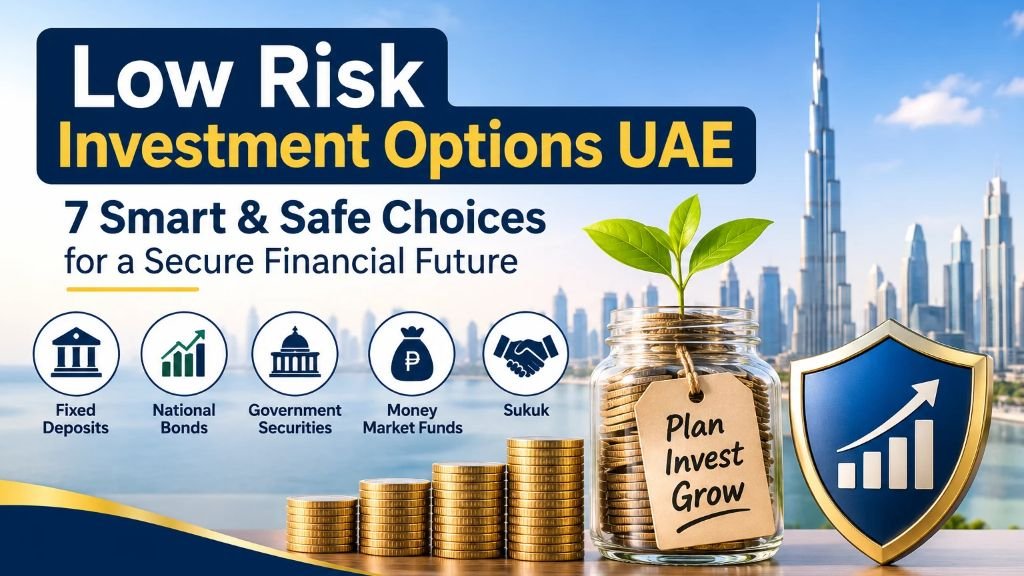
Investing money does not always mean taking significant financial risks. Many UAE residents, professionals, and expatriates prefer investment opportunities that focus on capital protection, predictable returns, and long-term financial stability. Choosing the right investment can help you grow your savings without exposing your entire portfolio to unnecessary market fluctuations. Understanding Low Risk Investment Options UAE can help you make informed financial decisions based on your income, savings, investment duration, and personal goals. Whether you are a beginner or an experienced investor, exploring safer financial opportunities is an important step towards building a secure financial future.
Table of Contents
What Are Low Risk Investment Options UAE?
Low-risk investments are financial products designed to reduce the possibility of losing your invested capital while offering an opportunity to earn returns.
These investments generally experience less price volatility than equities, individual stocks, or high-risk alternative investments. However, low risk does not mean zero risk. Inflation, interest rate changes, issuer default, liquidity restrictions, and currency fluctuations can still affect your investment.
For UAE residents, suitable options may include fixed deposits, government securities, National Bonds, money market funds, and high-quality sukuk.
The right choice depends on how much money you want to invest, when you need it, and how much uncertainty you are comfortable accepting.
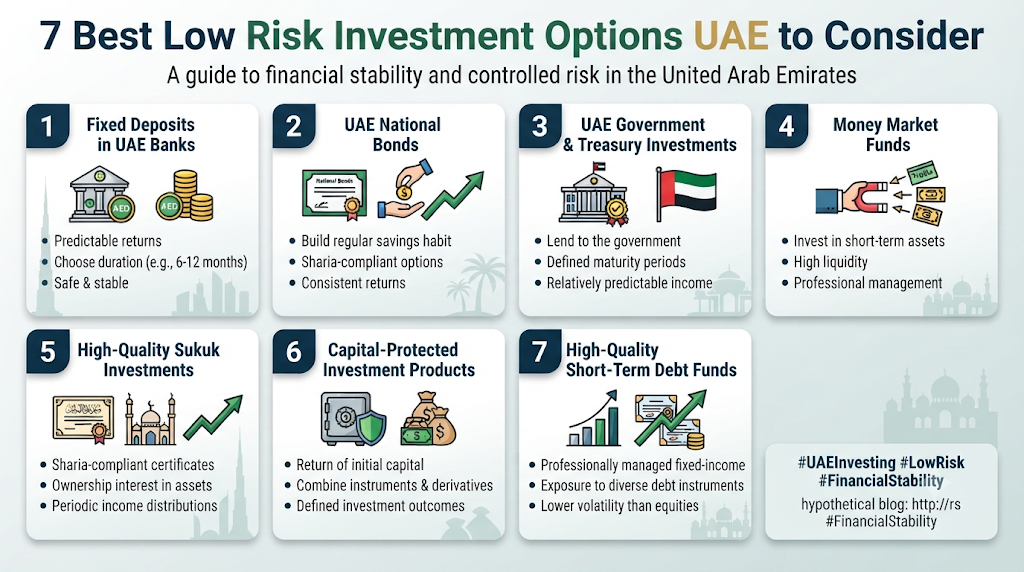
7 Best Low Risk Investment Options UAE to Consider
Here are seven investment opportunities worth exploring if your priority is financial stability and controlled risk.
1. Fixed Deposits in UAE Banks
Fixed deposits are among the most familiar investment choices for people who prefer predictable returns.
You deposit a specific amount with a bank for an agreed period. In return, the bank pays interest or an agreed profit, depending on the product structure.
Key benefits:
- Predetermined investment duration.
- Generally predictable returns.
- Different deposit tenure options.
- Suitable for short- and medium-term savings.
- Easy to understand for beginner investors.
For example, someone with AED 30,000 in savings may consider placing a portion into a fixed deposit for six or twelve months, depending on the available rates and withdrawal conditions.
Before investing, compare interest rates, early withdrawal penalties, minimum deposit requirements, and the applicable bank protection arrangements.
2. UAE National Bonds
National Bonds is a UAE-based savings and investment programme that provides residents with opportunities to save regularly and participate in investment-based returns.
It can be considered by individuals who want to develop consistent savings habits rather than invest large amounts at once.
Why consider it?
- Options for disciplined savings.
- Opportunities to contribute regularly.
- Different savings plans and investment structures.
- Sharia-compliant savings options.
- Potential returns based on the applicable product terms.
For example, an individual saving AED 500 every month can gradually build a financial reserve instead of waiting until they have a large amount available.
Always review the product’s terms, expected returns, withdrawal conditions, and capital protection features before participating.
3. UAE Government Bonds and Treasury Investments
Government securities can be suitable for investors who prioritise relatively stable investment opportunities.
These instruments allow investors to lend money to a government or government-related issuer in exchange for interest or profit payments, depending on the structure.
UAE government treasury instruments may provide exposure to government-backed debt markets, although availability and minimum investment requirements vary.
Important features:
- Defined maturity periods.
- Potentially predictable income.
- Exposure to government debt instruments.
- Different maturity options.
- Useful for portfolio diversification.
Investors should examine the issuer, credit quality, maturity date, yield, and whether selling before maturity could result in a capital loss.
4. Money Market Funds
Money market funds invest in short-term, relatively high-quality financial instruments, such as treasury bills, certificates of deposit, and short-term debt securities.
They are designed to provide liquidity and relatively stable returns compared with many equity investments.
Main advantages:
- Exposure to short-term financial instruments.
- Potentially convenient access to funds.
- Professional fund management.
- Diversification across multiple instruments.
- Suitable for certain short-term investment goals.
However, money market funds are not the same as bank deposits. Their returns can change, and the value of your investment is not necessarily guaranteed.
5. High-Quality Sukuk Investments
Sukuk are Sharia-compliant financial certificates that represent an ownership interest or beneficial interest in underlying assets, projects, or investment arrangements.
They can offer an alternative to conventional fixed-income investments for individuals seeking Sharia-compliant opportunities.
High-quality sukuk issued by financially strong entities may be considered for investors looking for relatively predictable income.
Benefits include:
- Sharia-compliant investment structures.
- Potential periodic income distributions.
- Different maturity periods.
- Opportunities to diversify a portfolio.
- Exposure to established issuers.
Before investing, assess the issuer’s creditworthiness, underlying structure, liquidity, maturity, and potential market price fluctuations.
6. Capital-Protected Investment Products
Some financial institutions offer structured investment products designed to return an agreed amount of initial capital at maturity, subject to specific contractual conditions.
These products may combine lower-risk financial instruments with derivatives to provide defined investment outcomes.
Potential advantages:
- A defined capital protection feature.
- Predetermined maturity dates.
- Potential participation in market-linked returns.
- Different investment structures.
However, capital protection is only as reliable as the issuer’s ability to meet its obligations. It may also apply only at maturity, not when the investment is sold early.
Read the product documentation carefully and understand any fees, restrictions, and conditions.
7. High-Quality Short-Term Debt Funds
Short-term bond and debt funds invest in relatively short-duration debt instruments issued by governments, banks, and companies.
These funds may suit investors who want professionally managed exposure to fixed-income securities without selecting individual bonds themselves.
Key considerations:
- Portfolio credit quality.
- Average maturity and duration.
- Management fees.
- Historical volatility.
- Redemption conditions.
Although these funds may offer relatively lower volatility than equity funds, they still carry credit, interest rate, and liquidity risks.
Comparison of Low Risk Investment Options UAE
Understanding the differences between investment products can help you select an option that matches your financial objectives.
| Investment option | Risk level | Potential benefit |
|---|---|---|
| Bank fixed deposits | Generally low | Predetermined returns |
| National Bonds | Product-dependent | Disciplined savings |
| Government securities | Generally low, issuer-dependent | Potential regular income |
| Money market funds | Relatively low | Liquidity and diversification |
| High-quality sukuk | Low to moderate | Potential income |
| Capital-protected products | Issuer and product-dependent | Conditional capital protection |
| Short-term debt funds | Low to moderate | Diversified debt exposure |
Note: Risk classifications are indicative, not guarantees. Actual risk depends on the specific product, issuer, maturity, fees, and market conditions.
How to Choose the Right Low-Risk Investment
Not every investment is suitable for every individual. Your financial situation, responsibilities, and future plans should influence your decision.
Consider these seven steps before investing:
- Define your financial goals: Decide whether you are saving for an emergency, education, retirement, property, or another objective.
- Understand your risk tolerance: Determine how much temporary fluctuation or potential loss you can realistically accept.
- Set your investment duration: Choose between short-term, medium-term, and long-term opportunities.
- Compare potential returns: Evaluate expected returns alongside fees, charges, and applicable taxes.
- Check liquidity: Understand how quickly you can access your money when required.
- Research the provider: Review the institution’s reputation, regulatory status, and product documentation.
- Diversify your investments: Avoid placing all your savings into one financial product or issuer.
Following these steps can help you make more informed investment decisions while reducing avoidable financial risks.
Important Factors UAE Investors Should Understand
Before selecting an investment, consider several factors that can influence your actual returns.
Inflation and Purchasing Power
Even when an investment generates positive returns, inflation can reduce the purchasing power of your money.
For example, if your investment earns 3% annually while inflation is 4%, your approximate return after inflation is negative 1%, before considering fees and taxes.
Liquidity and Withdrawal Conditions
Some investments allow withdrawals relatively easily, while others require you to wait until maturity.
If you may need your money unexpectedly, avoid locking all your savings into long-term products.
Currency Considerations
The UAE dirham is pegged to the US dollar. However, expatriates who eventually plan to spend their savings in another currency should consider potential exchange-rate movements between the dirham and their home currency.
Fees and Hidden Costs
Management charges, early withdrawal penalties, transaction fees, and other expenses can reduce your actual investment returns.
Always compare the net expected return rather than focusing only on advertised rates.
Practical Example: Investing AED 1,000 Every Month
Suppose a UAE resident decides to save AED 1,000 every month.
Instead of investing the entire amount in one product, they could explore a combination of accessible savings, fixed deposits, and suitable money market investments.
After one year, their total contributions would be AED 12,000, excluding any investment returns.
This approach demonstrates how regular contributions can help develop financial discipline without requiring a substantial initial investment.
The actual return will depend on the selected products, applicable rates, fees, and investment duration.
CWhy Choose Low Risk Investment Options UAE for Financial Security?
Choosing Low Risk Investment Options UAE can be a practical approach for individuals who want to protect their savings while earning potential returns. Many UAE residents prefer investment opportunities that offer financial stability, manageable risk, and flexibility. Options such as fixed deposits, National Bonds, money market funds, and government securities can help investors create a balanced financial strategy. These Low Risk Investment Options UAE are worth exploring for salaried professionals, expatriates, families, and first-time investors who want to manage their money responsibly. Before selecting an investment, compare expected returns, investment duration, liquidity, and associated charges to ensure the product supports your financial objectives.
How Low Risk Investment Options UAE Support Long-Term Wealth Planning
Including Low Risk Investment Options UAE in your financial plan can help establish a disciplined approach to saving and wealth creation. Instead of depending on a single investment product, consider diversifying your savings across suitable financial instruments according to your budget and risk tolerance. For example, you may keep emergency funds accessible while allocating another portion of your savings to fixed deposits or suitable short-term debt investments. This strategy can help manage financial uncertainty while maintaining opportunities for potential growth. With the right financial planning, Low Risk Investment Options UAE can support important goals such as retirement preparation, children’s education, future property purchases, and long-term financial independence.
Frequently Asked Questions (FAQs)
1. What are the safest investment options in the UAE?
Bank fixed deposits, suitable government securities, and certain high-quality money market products are commonly considered relatively conservative investment choices. Their actual safety depends on the issuer, product terms, and applicable protections.
2. Can I start investing with AED 500 in the UAE?
Yes. Some savings programmes and investment products allow individuals to begin with relatively small contributions. Minimum investment requirements vary between providers and products.
3. Are low-risk investments profitable?
Low-risk investments can generate returns, but their potential returns are generally more modest than those associated with higher-risk investments. Actual performance depends on market conditions, fees, and product terms.
4. Are fixed deposits better than mutual funds?
Fixed deposits generally offer more predictable returns over an agreed period, while mutual funds provide exposure to a portfolio of investments with varying risk levels. The better option depends on your financial goals, investment duration, and risk tolerance.
5. How can expatriates invest safely in the UAE?
Expatriates should compare regulated financial institutions, understand investment and withdrawal conditions, assess currency considerations, and select products that match their financial goals and future plans.
Related Insights: Topics to Explore
- Safe Investment Plans for Beginners in UAE
- Monthly Investment Plan in UAE
- Best Investment in UAE
- Small Investment in UAE
- Financial Planning in Dubai
- Wealth Management Companies in Dubai
Conclusion
Building financial security does not require taking unnecessary investment risks. By exploring fixed deposits, National Bonds, government securities, money market funds, sukuk, and other suitable financial products, UAE residents can identify opportunities that match their savings goals and financial circumstances.
The best approach is to understand the risks, compare actual returns, maintain sufficient liquidity, and diversify your investments. Choosing suitable Low Risk Investment Options UAE can be an important step towards creating a disciplined and sustainable financial plan.
Looking for professional investment guidance in the UAE? Contact Bricks Consultancy to explore suitable financial planning and investment opportunities based on your goals, budget, and risk preferences.