<!-- Google tag (gtag.js) --> <script async src="https://www.googletagmanager.com/gtag/js?id=G-FNVKYB7G4T"></script> <script> window.dataLayer = window.dataLayer || []; function gtag(){dataLayer.push(arguments);} gtag('js', new Date()); gtag('config', 'G-FNVKYB7G4T'); </script>



What if a small amount saved every month could become a meaningful financial cushion over time? A monthly saving plan in UAE helps residents create a disciplined approach to saving instead of relying on whatever money remains at the end of the month. Whether your goal is an emergency fund, a home, education, retirement, or future investments, regular saving can make financial planning easier. With the right approach, you can choose a realistic monthly amount, manage expenses, review your progress, and adjust your strategy as your income and goals change.
Table of Contents
What Is a Monthly Saving Plan in UAE?
A monthly saving plan in UAE is a structured financial approach where you set aside a fixed amount from your monthly income toward specific financial goals.
Instead of saving occasionally, you make saving a regular part of your budget. The money may be kept in a suitable savings account or allocated toward appropriate financial products, depending on your objectives, risk tolerance, time horizon, and personal circumstances.
Simple definition: A monthly saving plan is a systematic method of setting aside money every month to build financial reserves and work toward short- or long-term financial goals.
For UAE residents, this approach can be particularly useful because household expenses, housing costs, education, transportation, insurance, and lifestyle spending can make irregular saving difficult.
Why Is Monthly Saving Important in the UAE?
Saving consistently provides structure to your financial life. It can help you prepare for expected expenses while creating a buffer for unexpected situations.
A good saving habit can help you:
- Build an emergency fund
- Prepare for major future expenses
- Reduce dependence on borrowing
- Create funds for education or home ownership
- Prepare for retirement
- Develop better spending discipline
- Create capital for future investment opportunities
The objective is not necessarily to save the largest amount possible. The more important factor is choosing an amount that is realistic and sustainable.
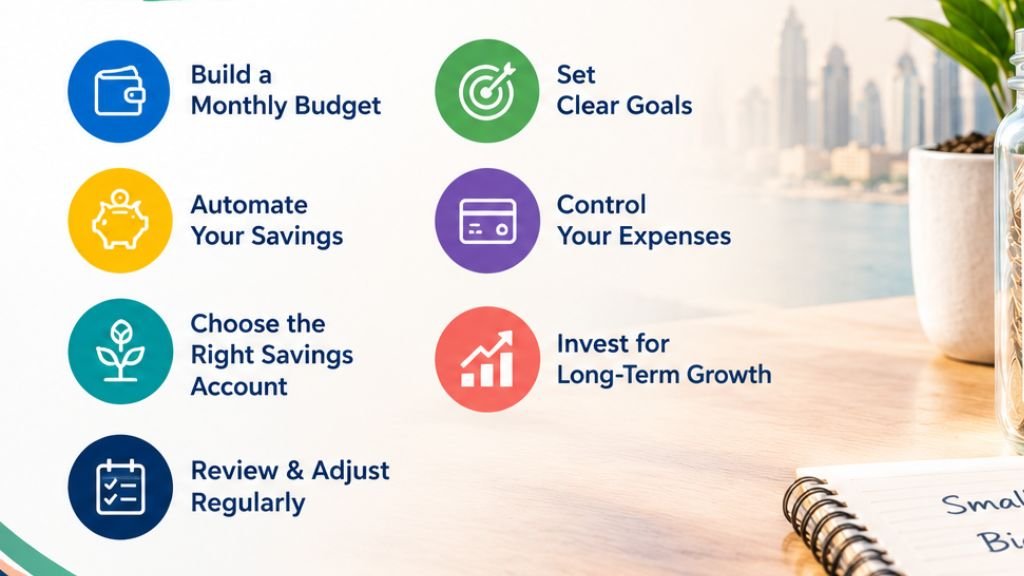
Monthly Saving Plan in UAE: 7 Smart Steps
Creating a plan does not have to be complicated. A practical process can help you turn your income into a more organized financial strategy.
1. Calculate Your Monthly Cash Flow
Start by identifying your monthly income and essential expenses.
Include rent, utilities, groceries, transportation, insurance, loan payments, school fees, subscriptions, and other recurring costs. Then identify discretionary spending that could potentially be reduced.
The amount left after essential expenses provides a starting point for deciding how much you can save.
2. Set a Clear Financial Goal
Saving without a goal can make it easier to spend the money elsewhere.
Give each major saving objective a purpose. For example, you might save for an emergency reserve, a family expense, a property down payment, or retirement.
A specific goal also makes it easier to determine how much you need to save and for how long.
3. Choose a Realistic Monthly Amount
Avoid creating a plan that puts unnecessary pressure on your monthly budget.
For example, if you can comfortably save AED 1,000 every month, consistency may be more useful than setting an unrealistic target of AED 3,000 and repeatedly missing it.
As your income increases, you can review the amount and potentially increase your monthly contribution.
4. Automate Your Savings
Automation can make saving easier because the money is transferred before it becomes part of your everyday spending budget.
Consider arranging a regular transfer shortly after receiving your salary, subject to the terms of your bank or financial product.
This turns saving into a routine rather than a decision you need to make every month.
5. Separate Short-Term and Long-Term Goals
Not all savings should be treated the same way.
Emergency funds and upcoming expenses generally require accessibility, while longer-term goals may have a different time horizon and risk profile.
Separating your goals can make your financial plan easier to manage and review.
6. Review Your Plan Regularly
Your financial circumstances can change.
Salary increases, family responsibilities, rent changes, new loans, or major expenses can affect your ability to save. Review your plan periodically and make adjustments when appropriate.
Professional financial planning can also help you understand how different saving and investment choices fit into your overall objectives.
7. Keep Increasing Your Saving Capacity
Once your basic plan becomes comfortable, consider increasing your monthly contribution gradually.
A salary increase, annual bonus, or reduction in an expense can create an opportunity to strengthen your savings.
Small increases can make a difference over a long period without requiring a major lifestyle change.
Comparing Different Saving Approaches
Different financial goals may require different approaches. There is no single solution that suits every resident.
| Saving Approach | Typical Purpose | Accessibility | Key Consideration |
|---|---|---|---|
| Regular savings | Emergency or short-term needs | Generally high | Interest/return and account terms |
| Fixed deposit | Planned short-term goals | Varies | Lock-in period and rates |
| Long-term investment | Wealth-building goals | Varies | Market risk and time horizon |
| Insurance-linked planning | Protection and selected long-term goals | Depends on product | Charges, terms and benefits |
| Diversified financial strategy | Multiple goals | Depends on products | Requires regular review |
Before choosing a product, understand its fees, conditions, liquidity, potential returns, risks, and suitability for your circumstances.
How Much Should You Save Every Month?
There is no universal monthly saving amount.
A practical starting point is to first understand your income, essential expenses, existing debt, dependents, emergency requirements, and financial objectives.
For example, someone with substantial fixed expenses may start with a modest amount, while another person with higher disposable income may be able to save considerably more.
The important principle is consistency combined with affordability.
If your income varies each month, you can establish a minimum regular contribution and make additional contributions during months when your cash flow is stronger.
Role of Finance Companies in Dubai
Many residents seek professional guidance when they have multiple financial goals or are unsure how to structure their savings.
Finance Companies in Dubai and financial advisory professionals may provide guidance on budgeting, saving, insurance, investments, and broader wealth planning. However, consumers should understand the difference between general financial guidance and regulated financial services.
When considering Finance Companies in Dubai, look at factors such as:
- Transparency of fees and charges
- Qualifications and experience of advisers
- Range of financial solutions
- Clarity of product documentation
- Approach to risk assessment
- Ongoing review and support
A professional conversation can help identify gaps in your existing financial strategy and clarify which areas require further attention.
Common Mistakes to Avoid
Even a well-intentioned saving strategy can become ineffective if important factors are overlooked.
Saving Only When Money Is Left
Waiting until the end of the month can result in inconsistent contributions. Treating saving as a planned expense can create greater discipline.
Ignoring Emergency Savings
Long-term financial goals are important, but unexpected expenses can disrupt them. Building an appropriate emergency reserve can provide additional financial flexibility.
Choosing Products Without Understanding Them
Do not focus only on advertised returns. Understand risks, fees, withdrawal conditions, lock-in periods, and other terms before making a financial decision.
Failing to Review the Plan
A plan created several years ago may no longer match your current income, responsibilities, or objectives.
Building a Sustainable Saving Strategy
A sustainable monthly saving plan in UAE should fit your real financial circumstances.
For example, imagine a UAE resident earns AED 15,000 per month and determines that AED 1,500 can be allocated toward financial goals after reviewing essential expenses. Instead of treating this as one general pool, they could divide the amount between emergency savings and longer-term objectives.
This example is illustrative rather than a recommendation. The appropriate allocation depends on individual circumstances.
Professional advisers can help clients assess their goals, time horizons, risk tolerance, and existing financial commitments before selecting appropriate solutions.
How to Make Your Monthly Saving Plan in UAE More Effective
A monthly saving plan in UAE becomes more effective when it is connected to specific financial goals and reviewed regularly. Start by deciding how much you can comfortably save each month without affecting essential expenses. You can then divide your savings between short-term needs, emergency reserves, and long-term financial objectives. Reviewing your monthly saving plan in UAE every few months can help you increase contributions when your income improves or expenses decrease. Finance Companies in Dubai and qualified financial professionals can also provide guidance on budgeting, savings, investments, and wealth planning. Most importantly, stay consistent and avoid making financial decisions based only on short-term returns.
Benefits of a Monthly Saving Plan in UAE for Families
A monthly saving plan in UAE can help families organize their finances around important short-term and long-term goals. By setting aside a fixed amount every month, families can prepare for education expenses, holidays, home purchases, emergencies, insurance premiums, and retirement. A well-structured monthly saving plan in UAE also encourages financial discipline because saving becomes a regular part of the household budget rather than an occasional activity. Families can review their income and expenses regularly and adjust their saving amount as their financial responsibilities change.
Choosing the Right Monthly Saving Plan in UAE
Choosing a suitable monthly saving plan in UAE requires more than simply selecting a product with an attractive return. Consider your financial goals, investment timeframe, liquidity requirements, risk tolerance, fees, and expected commitments before making a decision. Finance Companies in Dubai and professional financial advisers may help individuals understand different saving and investment approaches and assess how they fit into a broader financial strategy. Before selecting a monthly saving plan in UAE, compare the terms carefully and make sure you understand the potential risks, charges, withdrawal conditions, and other important features.
Testimonials
“The structured approach helped me understand where my monthly income was going and how I could make saving more consistent.”
“Having clear financial goals made it easier for our family to stay disciplined with monthly savings.”
“Regular reviews helped me adjust my financial strategy as my priorities changed.”
Testimonials are illustrative examples and should not be presented as verified client statements unless supported by genuine client records.
People Also Ask:
What is the best monthly saving plan in UAE?
There is no single plan that is suitable for everyone. The appropriate approach depends on income, expenses, financial goals, investment horizon, liquidity requirements, and risk tolerance.
How much should I save every month in the UAE?
The amount depends on your personal cash flow and objectives. Start with an amount you can maintain consistently and review it as your financial circumstances change.
Can I combine savings with investments?
Yes. Some people maintain accessible savings for short-term needs while using suitable investment solutions for longer-term objectives. The appropriate combination depends on individual circumstances and risk tolerance.
Should I automate monthly savings?
Automation can make regular saving easier by transferring a predetermined amount according to your chosen schedule, subject to the terms of your bank or financial provider.
Can Finance Companies in Dubai help with financial planning?
Some financial firms and advisers provide financial planning and related services. Before engaging one, review its qualifications, applicable regulatory status, fees, products, and service terms.
Conclusion
A disciplined monthly saving plan in UAE can provide a practical framework for managing money and working toward future financial goals. The key is to understand your cash flow, establish clear objectives, automate regular contributions where appropriate, maintain suitable emergency reserves, and review your strategy as circumstances change.
If you are unsure how to structure your savings or connect them with broader financial goals, consider speaking with a qualified financial professional. Bricks Consultancy can help you assess your financial priorities and explore suitable planning approaches based on your individual circumstances. Start reviewing your finances today and take a structured step toward your future financial goals.